
Remembering the circle theorems is often easier than recognising which one a question needs. Several overlapping triangles and chords can make a diagram difficult to read. Start with the information you have been given: a diameter gives you a right angle, while a tangent becomes useful once you draw the radius to its point of contact.
It also helps to trace the two arms of the angle you are trying to find. Where they meet the circle tells you which chord or arc the angle stands on.
How to choose a circle theorem
If you need to find an angle, the features below can help you decide where to start. For a length, see the length relationships below. Some questions need more than one theorem.
These questions also use ordinary geometry: angles on a straight line total , angles in a triangle total , and equal radii make isosceles triangles.
Circle theorems for finding angles
A chord joins two points on the circle. An arc is part of the circumference between two points. A tangent touches the circle at one point. The relevant arcs, chords and angles are marked in gold in the diagrams.
Angles at the centre and circumference
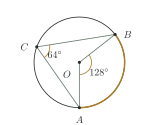
The angle at the centre is twice the angle at the circumference standing on the same arc.
Trace the arms of both angles to and . In this diagram, lies on the major arc, so both marked angles stand on the minor arc .
Use the arc that does not contain the circumference vertex. If that vertex lies on the minor arc instead, the matching central angle is reflex. Check which arc each angle stands on before applying the theorem.
Angles in the same segment
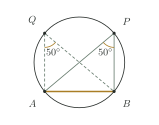
Angles standing on the same chord, with their vertices in the same segment, are equal.
Both pairs of arms end at and ; and are on the same side of chord . You can move the vertex along that arc without changing the angle.
Vertices on opposite sides of the chord do not generally give equal angles. Those two angles add to .
The angle in a semicircle
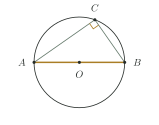
An angle subtended by a diameter at another point on the circle is a right angle.
The right angle is at , opposite diameter —not at one of the diameter’s endpoints. You can then use the triangle angle sum or Pythagoras.
A long chord is not automatically a diameter. Look for the centre on it, or a statement that it is a diameter.
Cyclic quadrilaterals
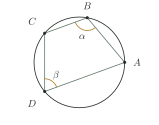
A quadrilateral whose four vertices lie on one circle is cyclic. Its opposite interior angles are supplementary.
Pair opposite corners, not adjacent ones. An exterior angle of a cyclic quadrilateral also equals the opposite interior angle.
Make sure all four vertices are stated to be on the circle. Otherwise, you need to prove that the quadrilateral is cyclic before using this theorem.
A radius and a tangent
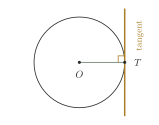
A tangent is perpendicular to the radius drawn to its point of contact.
If the radius is missing, drawing it can create a right-angled triangle. Another radius may then give you an isosceles triangle as well.
The radius must meet the tangent at the contact point. A chord reaching that point is not generally perpendicular to the tangent.
The alternate-segment theorem
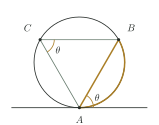
The angle between a tangent and a chord equals the angle subtended by that chord in the alternate segment.
Start at the point of contact , follow chord , then find the circumference angle facing that chord in the opposite segment. The two marked angles are equal.
The two tangent rays give supplementary tangent–chord angles. Match the marked angle to the alternate segment; do not simply choose whichever angle looks acute.
Worked examples
In a written solution, state the theorem that justifies each equation. This helps someone reading your working follow the steps, especially when you use more than one theorem.
Finding an angle at the circumference
In the centre diagram above, . Point is on the major arc . Find .
- Identify the matching arc. The angle at stands on the minor arc . The marked central angle stands on that arc too.
- Use the centre–circumference relationship.
A vertex on the minor arc. If a point were on the minor arc , its angle would face the major arc. Then . The location of the vertex changes the answer.
Finding unknown angles in a cyclic quadrilateral
is cyclic. Its opposite angles are and . Find and both angles.
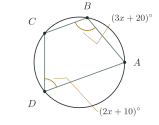
- Write the angle equation. Opposite angles in a cyclic quadrilateral add to , so their degree measures satisfy
- Solve the equation.
- Calculate both angles.
The angles total . Notice that is not itself either of the marked angles.
Using a tangent and equal radii
is the centre. The line through is tangent, and the marked tangent–chord angle is . Find and .
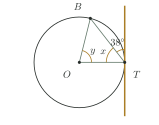
- Find the right angle. Radius is perpendicular to the tangent. The marked angles split that right angle:
- Use equal radii. Since , triangle is isosceles. Its angle at is also .
- Find the angle at the centre.
Another possible approach. The alternate-segment theorem would give an equal angle elsewhere on the circumference. That angle is not needed here: radius–tangent perpendicularity and equal radii are enough.
Circle theorems for lengths
Several circle theorems relate lengths rather than angles. Check for equal radii or equal tangent segments from one external point. If lines pass through the circle, one of the product relationships below may apply. These relationships can be proved using similar triangles.
If and are tangent segments from the same external point , then .
For chords and meeting at inside the circle:
From the same external point , with near points and far points on the two secants:
Here each product is external part × whole secant, not external × internal.
If is tangent and the secant meets the circle at near point and far point :
For example, an external part of and an internal part of make the whole secant . Use , so the positive tangent length is in the same length units.
See the configurations and practise length relationships →Three questions to try
For each question, decide which theorem applies and calculate the missing angle. The solutions are below each question.
Same side or opposite side?
lie on one circle. and are on the same side of chord . If , find .
Show solution
. Both angles stand on chord in the same segment. There is no central angle here to double.
Which corner is the right angle?
lie on a circle. is a diameter and . Find .
Show solution
The diameter gives . Then .
Which angles split the right angle?
A tangent touches a circle at . Radius and chord make . Find the acute tangent–chord angle.
Show solution
The radius is perpendicular to the tangent. The acute tangent–chord angle is . The angle using the other tangent ray is .
A note on diagrams
Circle diagrams are not always drawn to scale. A chord may look like a diameter without passing through the centre, and two angles that look equal may have different values. Use the marked information and the conditions of the theorem rather than measuring the picture.
Further reading
For proofs and further examples, see the Australian Mathematical Sciences Institute’s Circle Geometry teaching module.
Continue with cyclic-quadrilateral practice or browse the circle-geometry lessons.